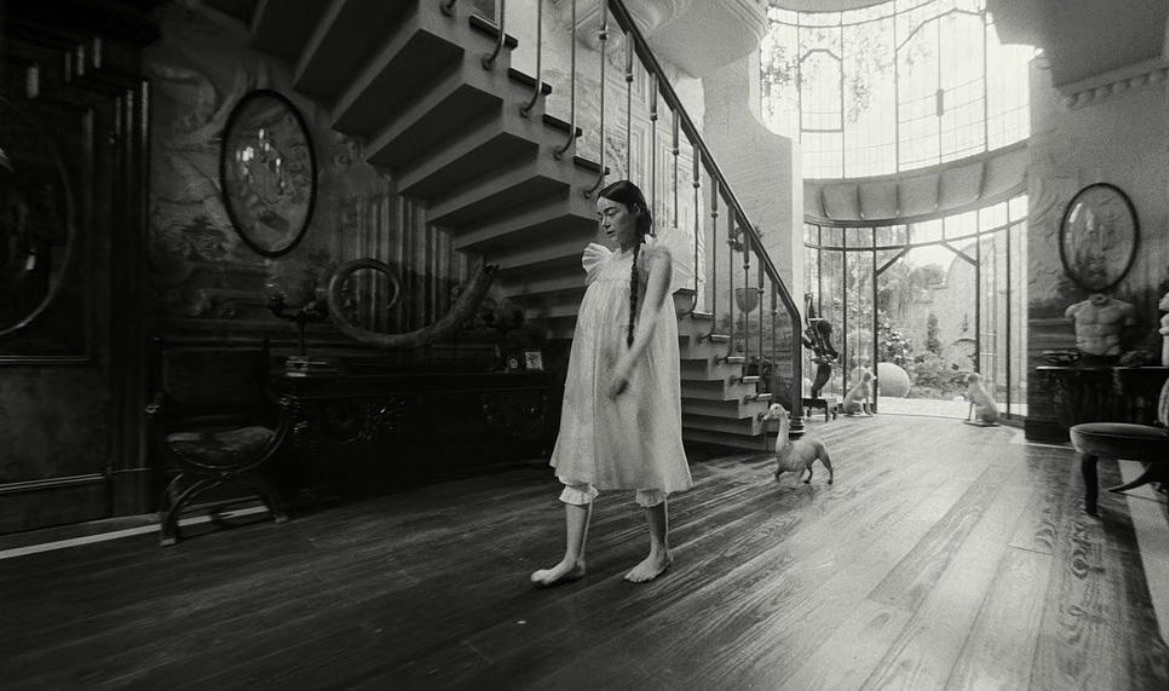
Poor Things Explained:
If you watched Poor Things expecting a traditional narrative arc, you misunderstood the assignment from the opening frame.
This is not a film built on comfort, clarity, or convention.
This is a film engineered through controlled chaos, psychological evolution, and decision-making under unfamiliar conditions.
In other words—this is Film IQ at its highest level.
Poor Things Explained: What Poor Things Is Really About (Beyond the Surface)
At face value, the film follows Bella Baxter’s introduction to the world—a journey of discovery, identity, and experience.
But structurally, it operates on a far more complex level:
It is a controlled experiment in human development.
Bella is not simply a character.
She is a system under observation.
- No social conditioning
- No inherited bias
- No predefined behavioral framework
Only:
Exposure → Experience → Adaptation
This is not traditional storytelling.
This is cognitive evolution in motion—a cinematic study of how intelligence, identity, and autonomy emerge under pressure.
Performance Analysis: Emma Stone Redefines Character Development
Bella Baxter stands as one of the most technically demanding performances in modern cinema.
Emma Stone does not simply “play” a character—she constructs one through layered progression.
Phase 1: Instinct
- Erratic movement
- Fragmented speech
- Reactive behavior
Phase 2: Exploration
- Curiosity replaces chaos
- Behavioral patterns begin to form
- Decision-making emerges
Phase 3: Autonomy
- Full control of body and language
- Intentional action replaces reaction
- Identity is realized
Most films skip developmental transitions.
This film earns every step—methodically, deliberately, and without compromise.
Cinematic Techniques: How Yorgos Lanthimos Forces Discomfort
1. Distorted Lenses Create Psychological Pressure
The exaggerated wide-angle cinematography is not aesthetic indulgence.
It is functional.
It:
- Disorients perception
- Distorts spatial awareness
- Generates subconscious tension
You are not watching passively.
You are being forced to process actively.
2. Artificial Worlds as Controlled Environments
Nothing in Poor Things feels natural—and that is precisely the point.
The environments are:
- Theatrical
- Hyper-designed
- Intentionally unreal
This is not a world.
It is a constructed system.
Lanthimos operates like a high-level experimental designer—controlling variables to observe behavioral outcomes.
3. Dialogue as a Marker of Intelligence
Language evolves alongside cognition.
Early dialogue:
- Mechanical
- Detached
- Clinical
Later dialogue:
- Fluid
- Emotional
- Intentional
Speech becomes a visible metric of intellectual growth.
Poor Things Ending Explained (Without the Simplistic Take)
The ending is not about narrative closure.
It is about ownership.
Bella transitions from:
- Controlled
- Defined
- Observed
To:
- Self-governing
- Self-defining
- Fully autonomous
The true conclusion is not external.
It is internal.
She is no longer the experiment.
Why Poor Things Divides Audiences
Let’s be direct—this film is not built for universal appeal.
It resonates if you:
- Value psychological depth
- Appreciate abstract storytelling
- Prefer interpretation over instruction
It fails if you:
- Require linear narrative
- Seek emotional comfort
- Expect traditional pacing
This is not entertainment-first cinema.
This is intellectual cinema.
The Film IQ Insight (Where This Becomes Powerful)
Here’s the deeper layer—and where this analysis extends beyond film.
Lanthimos constructs development the same way elite performance systems operate.
He does not:
- Instruct
- Guide
- Protect
He:
- Exposes
- Challenges
- Forces adaptation
Bella does not evolve through explanation.
She evolves because the environment demands it.
That is not just filmmaking.
That is high-level developmental design.
Final Verdict
Rating: 9.2 / 10 (Analytical Scale)
Not because it is easy to watch.
But because it is:
- Precise
- Deliberate
- Philosophically consistent
Final Thought
If most films are designed to tell you what to think—
Poor Things is designed to force you to think.
And that is the difference between content…
and mastery.
Leave a Reply