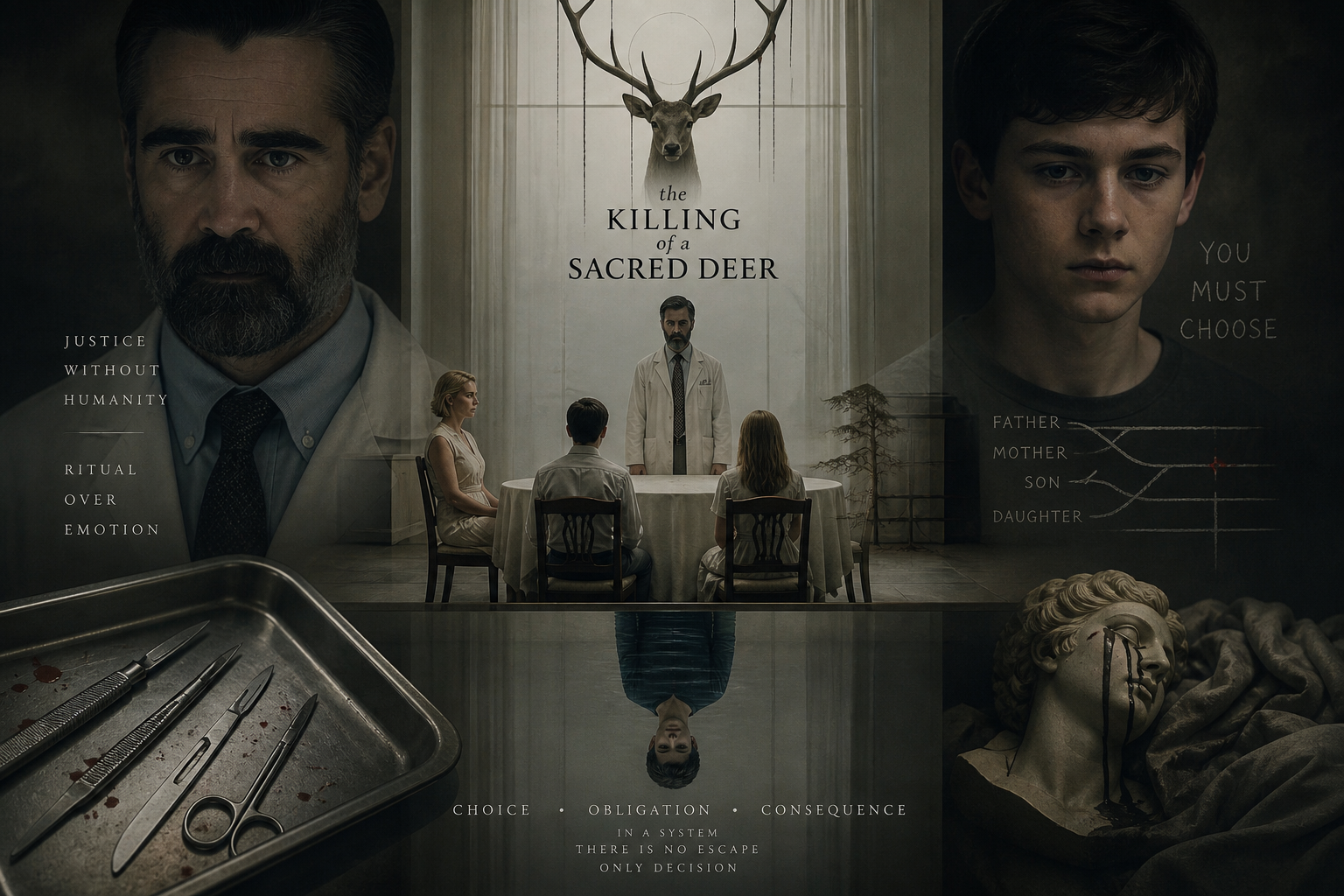
Yorgos Lanthimos’s The Killing of a Sacred Deer (2017) is a film that resists passive consumption. It is not merely watched; it is endured, decoded, and—perhaps most unsettlingly—internalized. Operating within the director’s now-recognizable grammar of emotional austerity and ritualized behavior, the film constructs a world in which morality is neither negotiated nor felt, but enforced through a cold, almost ceremonial logic. What emerges is a work that is as philosophically disquieting as it is formally controlled, situating itself within a lineage of tragic storytelling while reconfiguring that tradition through contemporary cinematic minimalism.

Synopsis: The Architecture of a Curse
The Killing of a Sacred Deer analysis situates one of my favorite films as a complex framework to study performativity and catastrophe.
The narrative centers on Steven Murphy, a successful cardiac surgeon, whose life appears meticulously ordered: a pristine home, a composed wife, Anna, and two children who function more like extensions of his environment than autonomous beings. This order is disrupted by Martin, a teenage boy with whom Steven has formed an ambiguous relationship. Martin’s presence, initially awkward yet benign, gradually reveals itself as something far more insidious.
When Steven attempts to distance himself, Martin imposes a moral ultimatum rooted in a form of retributive justice: Steven must choose one member of his family to sacrifice, or all will suffer a mysterious and fatal illness. What follows is not a descent into chaos, but rather a chilling escalation of procedural decision-making. The family does not fracture emotionally; instead, they adapt to the logic of the curse with a disturbing calm, as though participating in a ritual whose rules are immutable.
Performativity as Structure: The Language of Emotional Suppression
One of the most striking elements of Lanthimos’s film is its deliberate flattening of affect. Dialogue is delivered in a monotone register, stripped of inflection, urgency, or conventional emotional cues. This is not a stylistic quirk; it is a structural principle. The characters do not express emotion—they perform roles within an imposed system of behavior.
In this sense, the film operates as a study in performativity, echoing theoretical frameworks in which identity and moral action are not intrinsic but enacted. The Murphy family does not feel grief, fear, or desperation in recognizable ways; rather, they approximate these states through rehearsed gestures. The result is a profound estrangement effect. The audience is denied the catharsis typically associated with familial crisis, forced instead to confront the mechanics of decision-making absent of empathy.
This performative rigidity extends to the film’s visual language. The camera glides through sterile spaces with surgical precision, often framing characters in symmetrical compositions that emphasize their entrapment within an invisible system. The domestic sphere becomes a stage, and each character a participant in a ritual whose outcome is predetermined, even if its logic remains opaque.
Themes: Justice Without Humanity
At its core, The Killing of a Sacred Deer interrogates the concept of justice divorced from human feeling. Martin’s curse is not arbitrary; it is framed as a necessary balancing of moral scales. Steven, implicated in the death of Martin’s father during surgery, is subjected to a form of retributive justice that is absolute and non-negotiable.
What is remarkable is the film’s refusal to moralize this framework. There is no argument made for forgiveness, redemption, or resistance. Instead, the narrative presents a closed system in which justice operates with the inevitability of natural law. The ethical dilemma—who to sacrifice—is not treated as a question of love or value, but as a logistical problem to be solved.
This shift from emotional to procedural reasoning is where the film’s true horror resides. The audience is confronted not with monstrous acts, but with the normalization of those acts within a system that demands them. The final decision, executed with ritualistic detachment, is less a moment of climax than a confirmation of the film’s governing logic: that under certain conditions, morality becomes indistinguishable from mechanism.
Historical and Canonical Positioning: Rewriting Tragedy
Lanthimos’s film is explicitly indebted to the structure of Greek tragedy, particularly Euripides’ Iphigenia at Aulis, in which a father must sacrifice his child to appease divine forces. However, The Killing of a Sacred Deer does not simply adapt this narrative; it reframes it within a contemporary context devoid of gods, replacing divine will with an inscrutable yet implacable moral system.
In doing so, the film contributes to a modern reimagining of tragedy—one that strips away mythological ornamentation and locates the tragic within the banal spaces of suburban life. This aligns it with a broader movement in contemporary cinema that seeks to reengage with classical forms through minimalism and abstraction. Yet Lanthimos’s approach is distinct in its refusal of psychological realism. Where many modern films seek to humanize their characters, Sacred Deer renders them as vessels through which larger philosophical questions are enacted.
Within the canon, the film occupies a liminal space between art-house experimentation and classical narrative structure. It shares affinities with the works of Michael Haneke in its clinical detachment and moral ambiguity, while also extending Lanthimos’s own exploration of systems of control seen in Dogtooth and The Lobster. However, Sacred Deer marks a maturation of these concerns, achieving a level of thematic coherence and formal precision that solidifies its place as a significant work in 21st-century cinema.
Critique: The Risk of Emotional Sterility
The film’s greatest strength—its rigorous control of tone and performance—is also its most contentious aspect. By denying the audience access to conventional emotional cues, Lanthimos risks alienation. The characters’ detachment can be read not as a deliberate strategy, but as an absence of depth, leading some viewers to disengage from the narrative entirely.
Yet this critique may ultimately miss the film’s intention. The emotional sterility is not a failure of characterization, but a condition imposed by the film’s world. To demand emotional realism from The Killing of a Sacred Deer is to misunderstand its project. The film is not interested in how people feel, but in how they function within systems that render feeling irrelevant.
Conclusion: A Cinema of Uncomfortable Clarity
The Killing of a Sacred Deer is a film that refuses comfort, not only in its narrative outcomes but in its very mode of presentation. It confronts the viewer with a vision of morality stripped to its barest mechanics, where justice is enacted without compassion and decisions are made without hesitation.
In an era of cinema increasingly driven by emotional accessibility and narrative clarity, Lanthimos offers something far more unsettling: a work that demands intellectual engagement while withholding emotional release. It is, in many ways, a return to the fundamental purpose of tragedy—not to console, but to expose the limits of human agency within systems that exceed our understanding.
What remains, long after the film concludes, is not a sense of resolution, but a lingering question: what happens when the structures that govern our lives no longer require us to feel, only to choose?
FAQ: The Killing of a Sacred Deer — Themes, Performativity, and Meaning
1. What is The Killing of a Sacred Deer about at its core?
At its core, the film is about moral reckoning under an inescapable system of justice. It explores what happens when guilt—whether acknowledged or not—demands repayment, and that repayment cannot be negotiated, only enacted. The narrative transforms an ethical dilemma into a ritualized obligation, stripping away emotion and forcing decision-making into a cold, procedural space.
2. Why do the characters speak and behave so unnaturally?
This is a deliberate stylistic choice tied to performativity. The characters are not meant to feel psychologically realistic; instead, they function as agents within a system, performing roles rather than expressing inner emotional life. This flattening of affect creates distance, forcing the audience to engage intellectually rather than empathetically.
3. What does “performativity” mean in the context of this film?
Performativity here refers to the idea that identity and behavior are constructed through repeated actions rather than authentic emotional expression. The Murphy family does not respond organically to crisis—they enact responses as if following an unspoken script. Their humanity becomes secondary to the roles they are compelled to perform within the logic of the curse.
4. Is the curse supernatural, or symbolic?
The film resists a clear answer. The curse operates with supernatural precision, yet it is framed as a moral inevitability rather than a mystical anomaly. It can be read as:
- A literal supernatural force
- A manifestation of guilt
- A symbolic system of retributive justice without divine mediation
Its ambiguity is essential—it reinforces the sense that the characters are trapped in a system they cannot fully understand.
5. How does the film connect to Greek tragedy?
The film draws heavily from Euripides’ Iphigenia at Aulis, where a father must sacrifice his child to satisfy a higher power. However, Lanthimos modernizes this structure by removing the gods and replacing them with an impersonal moral mechanism. The result is a contemporary tragedy where fate is not divine, but systemic.
6. Why is the film so emotionally cold?
The emotional detachment is intentional. By removing traditional emotional cues, Lanthimos:
- Prevents catharsis
- Forces analytical engagement
- Highlights the mechanization of moral decision-making
The horror is not in what the characters feel, but in what they are willing to do without feeling.
7. Does the film offer any moral resolution or message?
Not in a conventional sense. The film avoids clear moral positioning and instead presents a closed ethical system. It does not argue for justice, forgiveness, or resistance—it simply demonstrates what happens when justice becomes absolute and inhuman.
8. Why doesn’t the family try to escape or fight the curse?
Because the film operates within a logic where resistance is irrelevant. The characters quickly adapt to the rules imposed on them, suggesting that:
- The system is totalizing
- Agency is limited or illusory
- Survival depends on compliance, not defiance
This reinforces the idea that they are participants in a ritual, not protagonists in a traditional narrative.
9. What role does Steven play in the larger thematic structure?
Steven represents institutional authority—rational, controlled, and detached. As a surgeon, he is accustomed to making life-and-death decisions with precision. The film extends this logic into the domestic sphere, exposing how clinical reasoning collapses when applied to moral catastrophe.
10. How does the film fit into Yorgos Lanthimos’s body of work?
It continues his exploration of:
- Systems of control (Dogtooth)
- Constructed social rules (The Lobster)
- *Emotional detachment and performativity
However, Sacred Deer is arguably his most direct engagement with classical tragedy, refining his style into a more focused and philosophically cohesive form.
11. Is the film meant to be disturbing or philosophical?
Both—and inseparably so. The disturbance arises not from spectacle, but from conceptual clarity. The film unsettles because it presents a world where:
- Logic overrides empathy
- Justice is indifferent to suffering
- Choice exists, but only within unacceptable parameters
12. What is the film ultimately asking the viewer to confront?
It asks a deeply uncomfortable question:
What remains of morality when it is stripped of emotion and reduced to obligation?
Rather than offering answers, the film positions the viewer within that dilemma—forcing a confrontation not with the characters, but with the structures that govern judgment, responsibility, and consequence.
Nicholas Serenati, Ph.D., is a filmmaker, visual theorist, and interdisciplinary researcher specializing in cinematic language, visual structure, and the philosophy of image-making. His work operates at the intersection of film theory and applied visual practice, where narrative is treated as a system of control, perception, and meaning rather than a vehicle for expression alone.
Drawing from both classical cinematic principles and contemporary analytical frameworks, Serenati’s writing interrogates how visual media constructs authority, organizes experience, and shapes interpretive outcomes. His scholarship extends across film analysis, visual culture, and research-based art, positioning his work within a broader discourse on structure, authorship, and the mechanics of storytelling.
Full academic publications are available on Academia.edu, with film and production credits documented on IMDb.
Leave a Reply